Custom quote
There is no list price; the quote is prepared around the licence model, modules and setup scope.
Rental or source code
You can use the software as a service or buy the source code.
About one week to set up
DIJI.TECH states that setup takes about a week on average and an extra module is activated in one business day.
Your own contracts
Supplier, virtual POS and accounting accounts belong to your agency; the software connects them.
The price of corporate travel software is not one number but the sum of several items. At Kurumsal.pro, the items that belong to the software (licence model, modules, setup) are part of DIJI.TECH's custom quote, while suppliers, virtual POS, accounting software and the domain name are your agency's own agreements. This page explains which questions to answer before you ask for a quote.
Why is corporate travel software not priced from a list?
Pricing is not listed because no two agencies need the same setup. One agency sells only flights and hotels, another also opens visa, bus and car rental; one rents the software, another buys the source code. DIJI.TECH therefore gives pricing only as a custom quote and publishes no list price, per-user fee or package table on the site.
The absence of a list price does not mean the cost is vague. The items that make up the quote are known and are explained one by one below. An agency that settles these items in advance can compare offers more reliably and avoids surprise extra work during setup.
Which items shape the quote?
The quote is shaped by the licence model, the modules you open, the setup scope and Diji usage; suppliers, the virtual POS, accounting software, the domain name and the TÜRSAB licence are your agency's own items. The table below shows who carries each item and what you should settle before requesting a quote.
| Item | What it determines | Whose account |
|---|---|---|
| Licence model | Rental (use as a service) or source code purchase | DIJI.TECH quote |
| Modules | Products opened in the portal: flights, hotels, transfers, car rental, tours, villas, yachts, activities, bus, visa | DIJI.TECH quote |
| Setup scope | Setting up the corporate portal, brand and domain settings, module activation | DIJI.TECH quote |
| AI assistant (Diji) | Usage-based billing infrastructure; terms stated in the quote | DIJI.TECH quote |
| Supplier agreements | Airline, GDS, hotel wholesaler, transfer, car and bus suppliers | Agency |
| Virtual POS or payment institution | Card collection with 3D Secure | Agency |
| Accounting and e-document software | e-Invoice / e-Archive document generation and ledger transfer | Agency |
| Domain name | The address the portal runs on, and its verification | Agency |
| TÜRSAB licence | The authority to sell travel services | Agency |
The rows marked "Agency" are outside the software but needed for the portal to work. For example, the portal brings flight results from your agency's supplier accounts; without those accounts it shows no flights. The suppliers you can connect are listed on the corporate travel integrations page, card collection on the payment integrations page and document generation on the accounting integrations page.
Rental or source code?
Both are possible. For its corporate travel management software, DIJI.TECH offers two licence paths: renting the software or buying its source code. Rental suits an agency that wants to use the software as a service without building its own team; source code suits an organisation that wants to own the product and develop it with its own software team.
| Question | Rental | Source code |
|---|---|---|
| Who is it for? | Agencies without a technical team, or those that want to start quickly | Organisations with their own software team that want to own the product |
| Starting load | You start with setup and brand settings | Scope and the working environment are planned in the quote |
| Development | New modules are opened by activation | Use and development terms for the source code are written in the quote |
| Settled in the quote | Duration of use and scope | Scope, terms of use and the support relationship |
On infrastructure, DIJI.TECH states that the platform runs on AWS and Cloudflare and uses a PCI DSS-compliant payment infrastructure. How hosting, version updates and support work under each model is written in the quote text. For a general comparison of the two routes, read the post on ready-made software versus source code.
How do the modules you open affect the cost?
Modules directly define the scope of the quote, and a module you skip at first can be added later. DIJI.TECH states that activating an additional module takes about one business day on average. You do not need to open every product on day one; you can start with the products your corporate clients use most.
The products that can be opened in the corporate portal are:
- Flights: one-way, round-trip and multi-city with 2 to 6 legs; fare packages; extra services offered by the airline such as seat selection, extra baggage and meals; the Turkish Airlines corporate code.
- Hotels: 1 to 6 rooms, an instant-confirmation and on-request filter, a map, and a policy decision per room.
- Transfers and car rental: a vehicle class filter; for cars, selecting and comparing the coverage packages offered by the supplier.
- Bus: trip search, seat selection from the seat map and purchase.
- Tours, villas, yachts, activities: your agency's own tours for tours; search, detail and cart for the others.
- Visa: closed by default for a company and opened per company by the agency.
Whether a product appears in the portal depends on three layers: it must be enabled on the platform, enabled on the corporate site, and selected as a visible product by the agency for that company. In the same installation you can therefore open only flights and hotels for one client and every product, visa included, for another. The details of each module are on the corporate travel management software features page.
How long does setup take and what does it cover?
DIJI.TECH states that setup takes about one week on average. The DIJI.TECH platform administrator opens the corporate portal through a 7-step wizard: tenant, corporate agency, first administrator, domain, brand, modules and a final check. If a step fails, everything done up to that point is rolled back, so no half-finished setup is left behind.
What your agency supplies affects the timeline most:
- Brand files: light and dark background logos, favicon, colours, legal name, support phone and email.
- Domain name: the portal does not open until the domain is verified, so the DNS change must be made on time.
- TÜRSAB and tax details: agency code, trade name, TÜRSAB number, tax number and tax office.
- Supplier and payment accounts: the access details to be defined on the platform.
- Legal texts: privacy (KVKK, the Turkish data protection law), terms of use and cookie texts, in Turkish and English separately.
After setup you open your first corporate client from the panel with a 3-step wizard; the company record, the default billing profile, the invitation to the company administrator and the default policy are created in one operation. The brand and domain side of setup is covered on the white label corporate booking tool page.
Who bears the cost of supplier, payment and accounting connections?
The commercial side of these connections belongs to your agency; the software only builds the technical link. The corporate portal uses the suppliers that are active in your agency's panel through the same search and cart infrastructure. Your corporate client sees the price and the result, but not the supplier name, the net price or your margin.
DIJI.TECH states that the platform has 100+ API integrations. Which supplier is opened in your installation depends on which suppliers you have agreements with. Card payments work the same way: collection runs through your agency's own panel payment line and its own bank or payment institution contract. On the accounting side, the Paraşüt, Luca, Logo Netsis, Arkman and SYS connections need your agency's own account with the relevant software.
How does the agency earn revenue from corporate clients?
The agency builds its revenue from corporate sales through three price layers: a service fee shown as a separate line on the invoice, a hidden markup built into the price and not visible on documents, and a commission. These layers are defined per company, by product and by domestic or international travel; subsidiaries and branches inherit the rules of their parent company.
The contract model with the company also affects revenue. In the "hidden margin" model the service fee is folded into the line price and the invoice lines merge into one line; in the "transparent" model the service fee appears separately. You can copy one company's price form to other companies with a preview. All of these tools are described on the corporate travel agency software page; for the definition of the fee, see service fee.
Which licence is needed to sell travel?
To sell travel services to corporate clients in Turkey, an agency needs a TÜRSAB licence; TÜRSAB is the Association of Turkish Travel Agencies. The agency's TÜRSAB number is entered during setup and shown in the portal. The conditions and fees of the licence are set by the relevant regulation and can change over time, so this site gives no figures on the subject.
What should you compare when you review offers?
Comparing two offers by total amount alone is misleading, because the same amount can describe very different scopes. When comparing offers, we recommend looking at these questions:
- Does the portal open for your corporate client under your own brand, domain and TÜRSAB number?
- Do the travel policy, multi-level approval, budget and reporting come in the same product, or as separate modules?
- Can the service fee, hidden markup and commission be defined per company?
- Are supplier, net price and profit information hidden from the client?
- Is the invoice addressed to the company's own billing profile, and does the sale land in your existing accounting line?
- Does the portal work in Turkish and English, and can it be used in a mobile browser?
On Kurumsal.pro, each of these questions is answered on the product pages. Telling DIJI.TECH at the quote stage which topic matters most to you helps set the scope correctly.
What should you prepare before asking for a quote?
The clearer the scope, the faster the assessment. It is enough to prepare the following in advance:
- Your preferred licence model: rental or source code.
- The modules you want to open first and those you may add later.
- The suppliers you work with and your virtual POS or payment institution.
- The accounting or e-document software you use.
- The domain the portal will run on and the state of your brand files.
- The scale of the corporate clients you plan to open and the languages they need (Turkish, English).
- Whether you want to use the Diji AI assistant.
DIJI.TECH states that it has been the technology partner of 50+ brands since 2019. To get a quote and see the portal with your own agency scenario, you can request a demo or email [email protected].
Screens
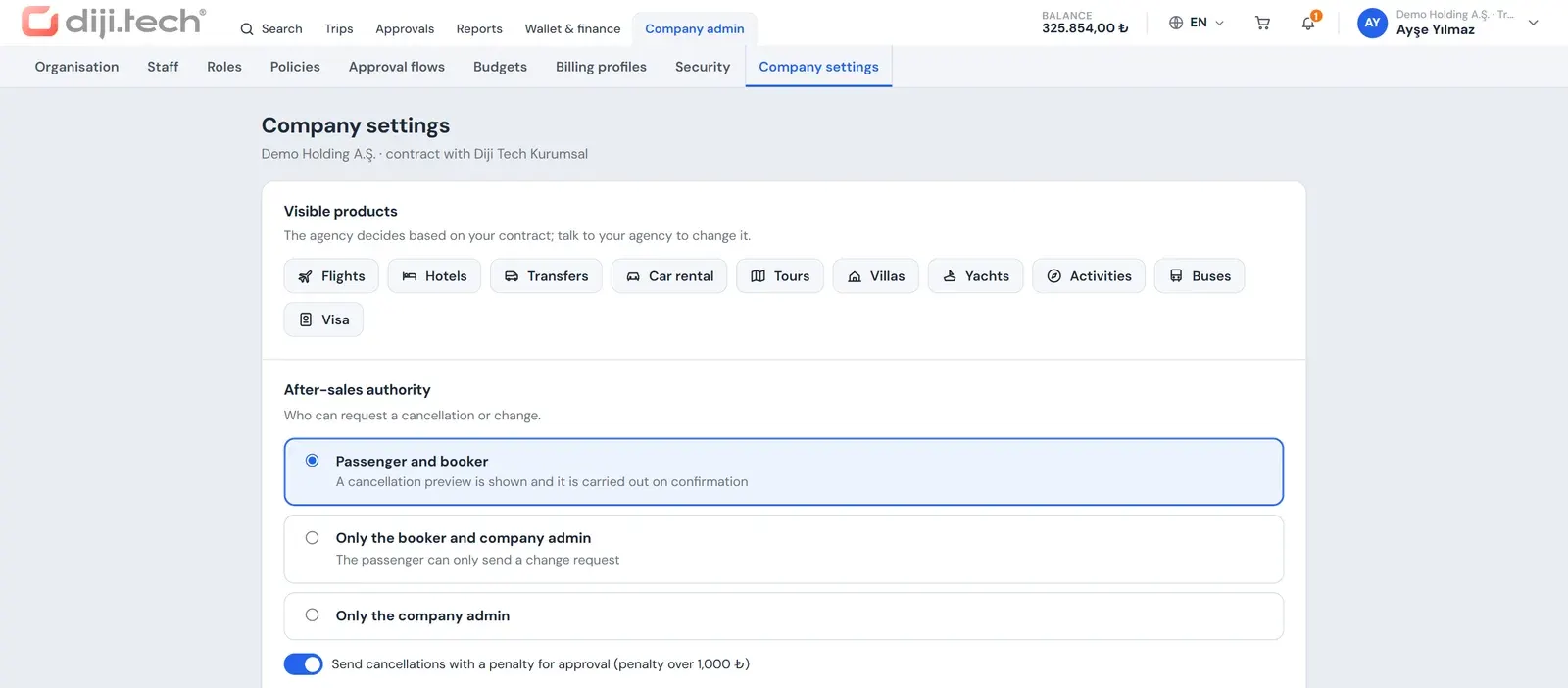
Screens are taken from the DIJI.TECH corporate portal and agency panel and show sample data.
Frequently asked questions
Why is there no corporate travel software price on the site?
Every agency opens a different set of modules, chooses its own licence model and needs a different setup scope. DIJI.TECH therefore gives pricing only as a custom quote. The site shows no list price, per-user fee or package price.
Can Kurumsal.pro be rented, or can the source code be bought?
Both options exist. DIJI.TECH offers the software as a rental, used as a service, or as a source code purchase. Which one fits depends on your technical team, your growth plans and how much customisation you need.
How long does setup take?
DIJI.TECH states that setup takes about one week on average. Once the portal is live, opening a new module takes about one business day. The timeline also depends on domain verification and on how quickly your supplier details are handed over.
Are supplier and virtual POS costs included in the quote?
No. These are your agency's own commercial agreements. The airline, hotel wholesaler, car rental or bus supplier contract and the bank or payment institution agreement are made in your agency's name; the software connects these accounts to the platform.
Does the number of users or companies affect the price?
The criteria behind the pricing are clarified in the quote; the site does not state a per-user or per-company fee. Sharing the number of corporate clients and staff you expect when you request a quote makes the assessment easier.
Is the Diji AI assistant charged separately?
The platform has a usage-based billing infrastructure for Diji. The terms and scope are stated in the quote; the site gives no credit, package or price information.
Which licence is needed to sell travel?
To sell travel services to corporate clients in Turkey, the agency needs a TÜRSAB licence (TÜRSAB is the Association of Turkish Travel Agencies). The agency's TÜRSAB number is entered during setup and shown in the portal. The conditions and fees of the licence are outside this page, so no figures are given.
How do you get a quote?
Leave a request on the DIJI.TECH demo page or email [email protected]. If you share the modules you want to open, your preferred licence model and the suppliers you work with, the quote is prepared around that scope.
Related pages
Last updated: