- Branded fares
- Branded fares are named airline fare packages that bundle rights such as baggage allowance and refund and change rules. Seats, extra baggage and meals outside the package are added separately as extra services.
- Also known as: branded fare, fare family, fare package, fare bundle, ticket package, fare brand
Branded fares are an airline fare structure in which fares within the same cabin are split into named packages. Each package carries its own baggage allowance, refund and change rule and price. Airlines give these packages different names; the shared logic is that the traveller sees up front what flexibility they are paying for.
What does a fare package determine?
A fare package determines the rights with which a ticket is sold. Package contents vary by airline and route; typically, the following rights differ from package to package:
- Cabin and hand baggage allowance
- Checked baggage allowance
- Ticket refund: whether it is refundable and whether a deduction applies
- Date or flight change: whether it is allowed and whether it carries a fee
- In some packages, seat selection or other services included in the package
On the same flight, the price gap between the most basic and the most flexible package can be significant. For that reason, package choice in corporate travel directly affects the balance between cost and flexibility.
What is the difference between a fare package and an extra service?
A fare package covers the rights of the ticket itself, while an extra service is a separate item added to the ticket. The package sets the baggage and refund rule; services the package does not cover, such as a seat, extra baggage or a meal, are added separately. One does not replace the other.
| Fare package (branded fare) | Extra service | |
|---|---|---|
| What it determines | Baggage, refund and change rights of the ticket | Separate items added to the ticket |
| Examples | No-baggage, baggage, flexible package | Seat selection, extra baggage, meal |
| When it is chosen | When the flight is selected | In the booking flow, after the package |
| Price | Package price | A separate price per service |
In Kurumsal.pro, the extra services the airline offers (seat selection from the seat map, extra baggage and meal selection) are chosen separately from the fare package and become part of the same cart, policy check and approval flow.
How do fare packages appear in Kurumsal.pro?
In the portal your agency offers its corporate clients, when an employee selects a flight, that flight's fare packages are listed. For each package the baggage allowance, the refund and change rule, and the price difference between packages are shown. The baggage rights of the selected package appear on the cart row, so employees can see what they are buying before submitting.
- The "with baggage" and "refundable" filters in search results help narrow down package differences from the start.
- Whether baggage is included can be set in the policy's "cheapest option" definition; the default definition is based on the option with baggage.
- The "maximum percentage gap to the cheapest" rule can flag an employee's choice of an expensive package as out of policy.
Fare packages come from the flight connections of the DIJI.TECH infrastructure (NDC connections, GDSs and consolidators), as far as the supplier supports them. How NDC carries package detail is explained in the NDC entry.
Does the agency quote include the fare package?
Yes. When agency staff make a sale on behalf of a company, they can prepare a quote PDF from the options selected in the search results. For flights, outbound and return are listed in separate sections and the selected baggage package (branded fare) is written into the quote. The company sees on the document which baggage and refund rights the quoted price covers.
How are fare packages handled in the travel policy?
The policy checks the outcome, not the package name: cabin, price gap and purchase timing. The company administrator defines the highest cabin, the permitted cabin on long flights and the allowed percentage gap to the cheapest option on the travel policy software screen. When an expensive package with change rights is needed, the employee writes an out-of-policy reason; if the rule's outcome is to send for approval, the request goes to the approver. Practical ways of saving through package choice are covered in the article on tips for saving money on corporate travel.
Screens
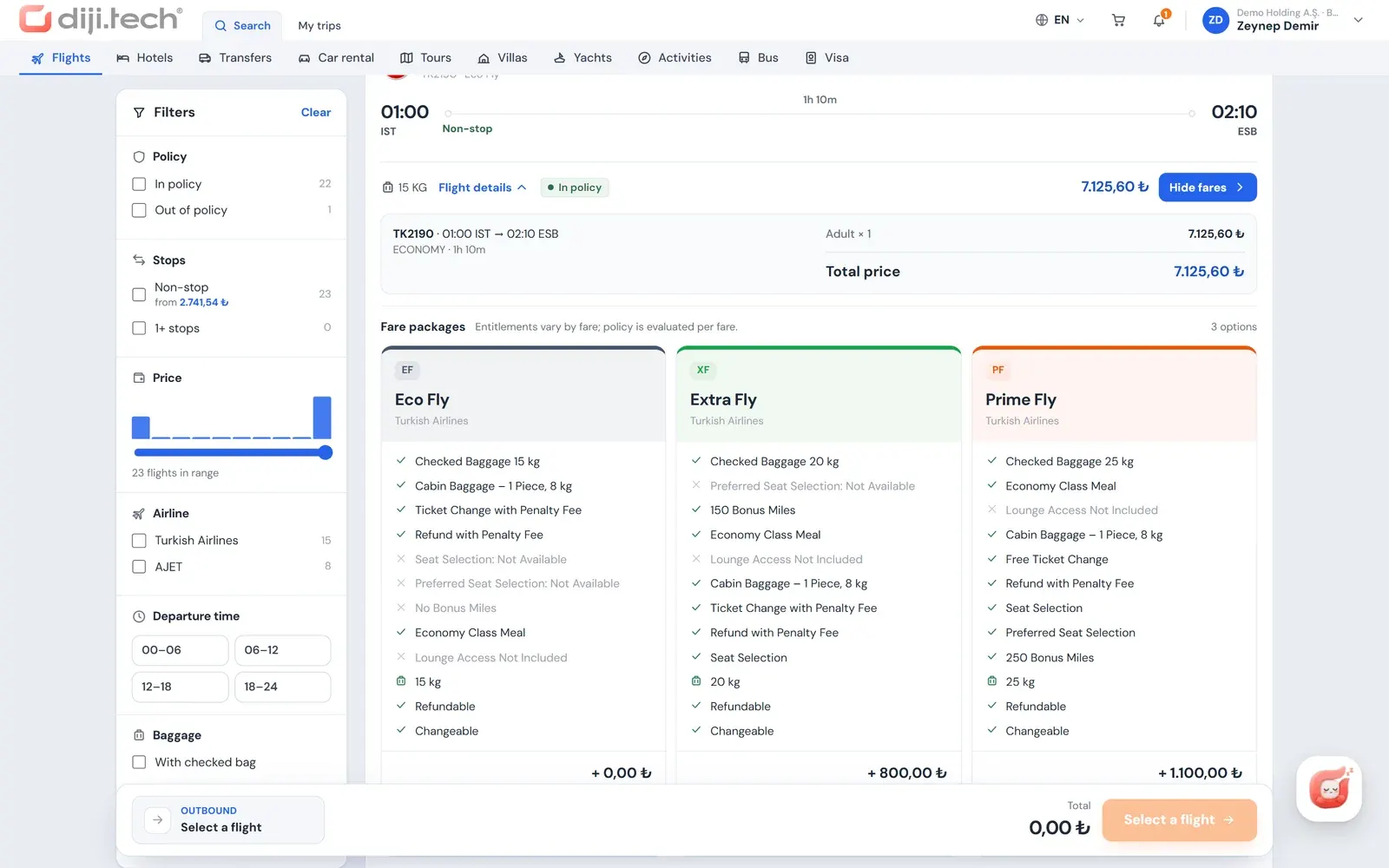
Screens are taken from the DIJI.TECH corporate portal and agency panel and show sample data.
Frequently asked questions
What does branded fare mean?
A branded fare is the structure in which an airline splits its fares into named packages. Each package defines rights such as baggage allowance and refund and change rules, and the traveller buys those rights together with the package price.
What is the difference between a fare package and an extra service?
The fare package determines the rights with which the ticket itself is sold. Extra services are items such as seat selection, extra baggage or meals added in the booking flow after the package is chosen. In Kurumsal.pro the two are presented and chosen separately.
Which package should be chosen in corporate travel?
It depends on the company's travel policy and the nature of the trip. A package with change rights can make sense for a meeting whose date is uncertain, and a narrower package for a short, fixed trip. The policy limits the choice through cabin and price-gap rules.
Does the selected package appear on the quote document?
Yes. When agency staff prepare a quote PDF on behalf of a company, the selected fare package is written into the quote, so the company sees on the document which baggage and refund rights the price covers.
Related pages
Last updated: