- B2B2E (business-to-business-to-employee)
- B2B2E (business-to-business-to-employee) is a model in which a business agrees with a company and serves that company's employees. In corporate travel the agency contracts with the company and employees book through the portal.
- Also known as: business-to-business-to-employee, B2B2E model, agency-company-employee channel, corporate channel, B2B2E travel
B2B2E (business-to-business-to-employee) is a sales model in which a business makes an agreement with another company and offers its service to that company's employees. The contract is between two businesses, but the service is used by the company's employees. Corporate travel is a typical example of this model: the agency agrees with the company, and the company's employees use the airline-ticket and hotel booking service.
Who are the parties in a B2B2E model?
B2B2E has three parties, and each has a different role: the business providing the service, the company buying it and the employee using it. In corporate travel the three line up as follows:
| Party | Counterpart in corporate travel | Role |
|---|---|---|
| Business (B) | Travel agency | Supply, pricing, operations, after-sales |
| Company (B) | Corporate client | Contract, rules, budget, invoicing |
| Employee (E) | The company's staff | Search, booking, travel |
The defining feature of the model is that the rules come from the company that pays and the use comes from the employee. The employee chooses their own trip, but chooses within the company's policy, approval workflow and budget.
What is the difference between B2B2E, B2B and B2C?
B2B2E is the model in which buyer and user are different people; in B2B and B2C the buyer and the user are the same. In B2C an individual customer buys their own trip. In tourism, B2B mostly means an agency selling to other agencies. In B2B2E the company buys and sets the rules, while the employee uses.
| Model | Buyer | User | Who sets the rules? |
|---|---|---|---|
| B2C | Individual customer | The same person | The customer |
| B2B | Agency or business | The same business | The business |
| B2B2E | Company | The company's employee | The company |
The difference between a B2B platform and a corporate portal is covered in detail in the article on B2B flight and hotel booking system infrastructure.
How is the B2B2E channel set up in Kurumsal.pro?
In Kurumsal.pro the B2B2E channel runs through the portal the agency offers its corporate clients under its own brand. Setup is done by the DIJI.TECH platform administrator: the corporate agency is defined, and the portal's domain, brand, languages and modules are configured. Only one corporate agency can be live at a time in a platform tenant. Details are on the white label corporate booking tool for TMCs page.
Once the channel is set up, the work of the three parties divides as follows:
- Agency: Opens the company, defines the company-specific price (service fee, hidden markup, commission), distributes balance to the company wallet, assigns representatives and handles after-sales requests. All of this is described on the corporate travel agency software page.
- Company: The company administrator manages the company tree, employees, roles, travel policy, approval workflow, budgets and billing profiles in the portal.
- Employee: Searches at the company price in the portal, sees the policy decision on every row, and buys the cart or sends it to approval. The flow is detailed on the self-booking tool page.
What does the B2B2E model give the agency?
B2B2E gives the agency access to all travelling employees of a company under a single contract. Because employees make a significant share of the bookings themselves, the agency's team deals not with routine requests but with work that takes effort, such as changes, cancellations and special requests. Because the company's rules are defined in the portal, there is no need to collect approval by email for every request.
The model also gives the company visibility: spend, policy compliance and budget use are tracked in one place. This two-sided benefit also lays the groundwork for a long-term relationship with the corporate client.
Where does agency staff stand in the B2B2E channel?
Alongside employees' own bookings, agency staff offer a second way to sell. They select a company and a person from the top bar of the panel; the search runs with that company's price and rules, and the sale falls into the same company's record. Bookings employees make in the portal and requests the agency takes by phone or email are therefore collected in the same company record; in the company's policy compliance report, the agency sale appears as a separate channel. This route is described on the agent-assisted corporate booking page.
Screens
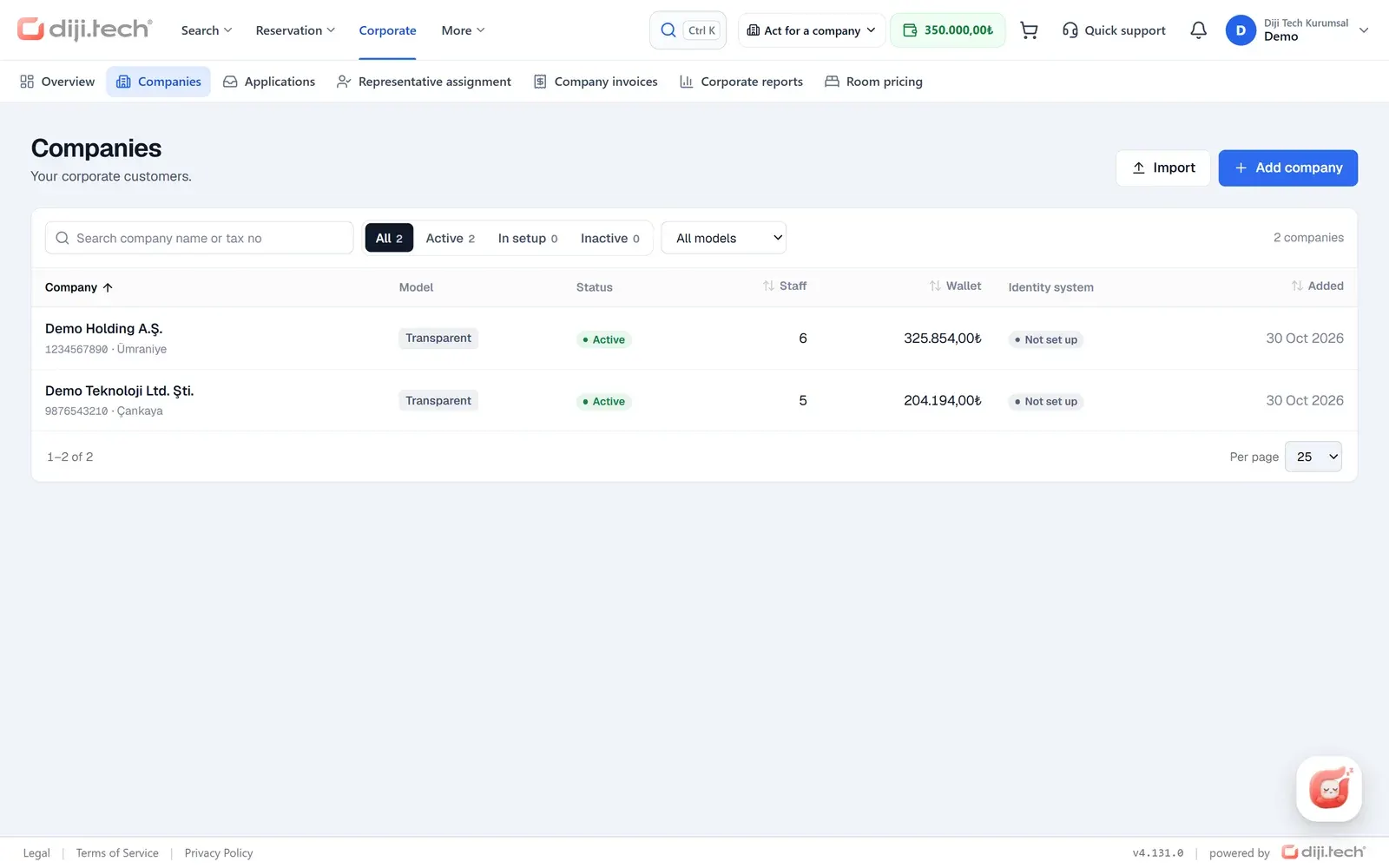
Screens are taken from the DIJI.TECH corporate portal and agency panel and show sample data.
Frequently asked questions
What does B2B2E mean?
B2B2E stands for business-to-business-to-employee. A business makes an agreement with a company and offers its service to that company's employees. The company sets the invoicing and the rules, and the employee uses the service.
What is the difference between B2B2E and B2B?
In B2B the buyer is the business itself; in tourism this mostly means an agency selling to other agencies. In B2B2E the buyer is the company and the end user is that company's employee, who books under the company's rules.
How does B2B2E work in corporate travel?
The agency contracts with the company and opens a portal for it. The company's administrator defines the policy, approval workflow and budget. Employees search at the company's price in the portal; if the booking is within policy and budget they purchase it, and if there is a policy violation that needs approval or a budget overrun that sends it to approval the request goes to approval (under a blocking rule the purchase cannot be made). The invoice is issued to the company.
Is Kurumsal.pro a B2B sub-agency platform?
No. Kurumsal.pro is the software for the B2B2E channel, in which an agency serves its corporate client and that client's employees. A B2B platform that sells to sub-agencies is not the subject of this portal.
Related pages
Last updated: