- Approval delegation
- A delegate approver is a person authorised, for a date range set by the main approver, to approve or reject travel requests in their place; the decisions they make are marked as made by a delegate in the approval history.
- Also known as: delegate approver, approval delegation, substitute approver, proxy approver, backup approver, delegation of authority
A delegate approver is a person who approves or rejects travel requests in place of the main approver when that person cannot decide because of leave, travel or workload. Delegation is usually given with a start and end date. The request does not leave its place in the approval workflow; only the people who can decide at that level widen for the period.
Why is a delegate approver needed?
A delegate approver prevents requests from piling up while the approver is away. A manager's two-week leave can freeze every trip of the team. Meanwhile flight prices rise, hotel rooms fill up and travelers who cannot get approval drift to out-of-policy or last-minute choices.
Delegation solves this risk with one setting made before the leave. It replaces off-the-record routes, such as the manager sharing a password or forwarding requests by email to someone else, and keeps it traceable who decided on whose behalf.
How does delegation work?
Delegation works by the main approver granting decision authority to a specific person for a specific date range. Within that range, requests that would reach the main approver also reach the delegate. When the delegate decides, the request moves on as if the main approver had decided, while the decision is recorded under the delegate's name.
A typical delegation carries this information:
- Main approver: the person being substituted.
- Delegate: the person who will decide.
- Date range: the day the delegation starts and ends.
- Record: every decision by the delegate is marked as made by a delegate.
Delegation, escalation and parallel approval compared
All three methods stop approval from stalling, but in different ways. Delegation is planned and changes the person; escalation starts when time runs out and changes the level of the request; an "any one" setting on a parallel level permanently spreads authority across several people.
| Method | When it applies | What changes | Suitable case |
|---|---|---|---|
| Delegation | On the dates set by the main approver | The person who decides | Planned leave, long trips |
| Escalation | When the level's time runs out | The level where the request sits | Unexpected delay |
| "Any one" level | Always | The number of authorised people at the level | Several approvers on a continuing basis |
Example: delegation for a leave period
Before a two-week annual leave, a sales director names a senior manager from the team as delegate for the leave dates. During those two weeks, requests from the team that would reach the director at level 1 also reach the delegate. The delegate approves in-policy requests quickly; a hotel request above the nightly cap is judged on its reason and, if not found suitable, rejected with a written explanation.
When the director returns, the approval history shows separately which decisions were made by the delegate. Because delegation ends on the last day of leave, the delegate's authority closes by itself and nobody has to undo the setting. An escalation rule remains as a backup for cases where even the delegate cannot decide.
Good practice for delegation
Delegation should go to someone with the same level of authority and information as the approver. A delegate who knows the team's travel needs and the policy keeps decisions consistent. The period should be limited to the leave dates and never left open-ended.
It also helps for the main approver to review the delegate's decisions in the approval history after returning. To avoid the risk of approving one's own request, the delegate should preferably not be the owner of the requests being approved.
Approval delegation in Kurumsal.pro
In the Kurumsal.pro portal that your agency offers its corporate clients, delegation is defined with a date range from the "Delegate assignment" tab of the Approvals screen. The delegate must be an active employee of the same company with a portal account.
- The delegate sees the requests that reach them in a separate "As delegate" tab.
- The delegate can approve, reject and, when enabled in the workflow, choose an alternative per item.
- At a level, only the approver of the current level or their delegate can decide.
- The delegate's decisions are marked "as delegate" in the approval history.
- Rejection requires a reason and an explanation from the delegate as well.
For all approval screens see travel approval workflow, and for the general structure of the process see approval workflow.
Screens
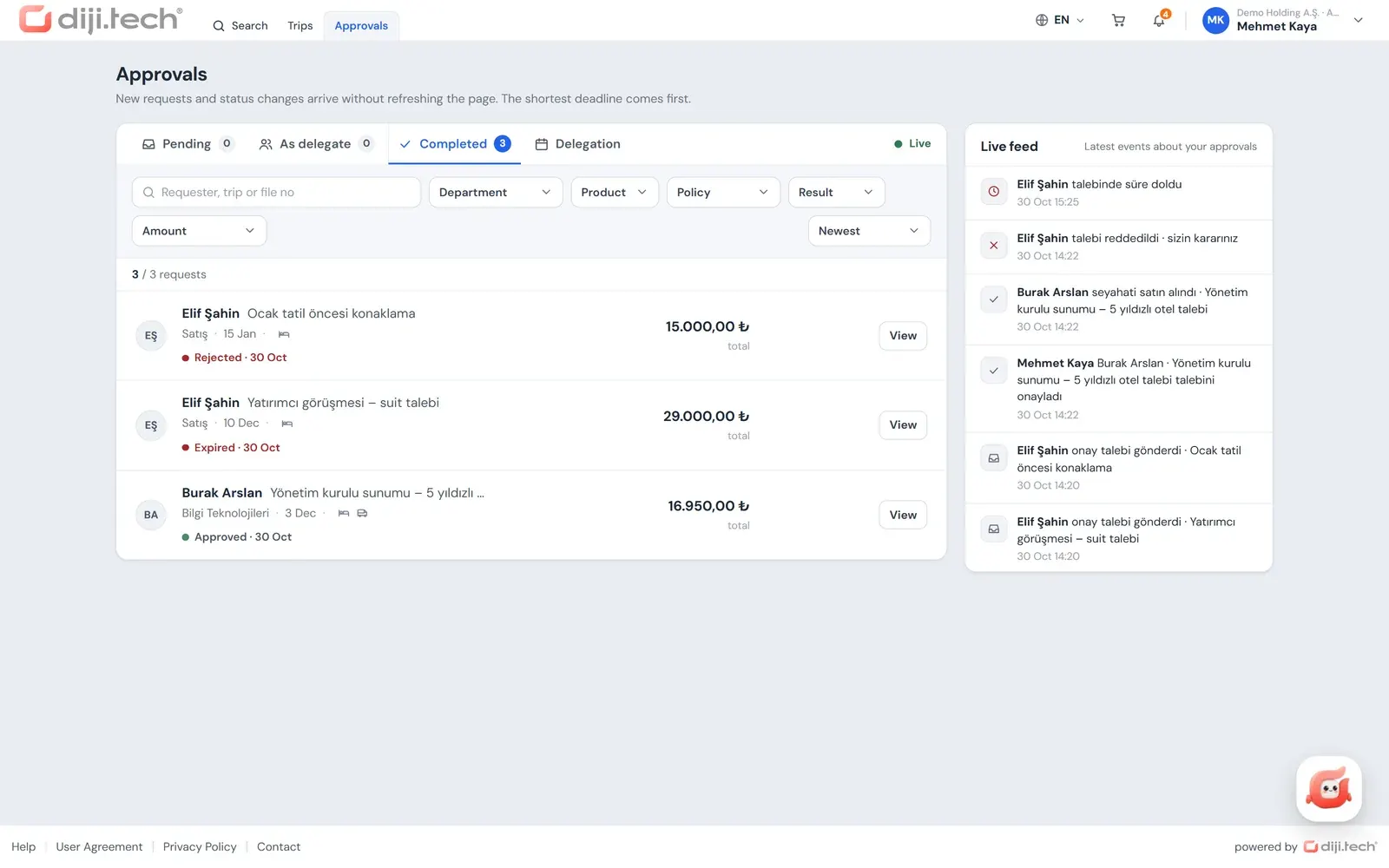
Screens are taken from the DIJI.TECH corporate portal and agency panel and show sample data.
Frequently asked questions
What is a delegate approver?
A delegate approver is a person who has the authority to decide in place of an approver who is absent. In corporate travel it is used mostly during annual leave, long business trips and busy periods so that requests waiting for approval do not pile up.
What is the difference between delegation and escalation?
Delegation is given in advance and on purpose; the delegate decides at the same level in place of the main approver. Escalation happens when the time limit runs out and moves the request to an upper level or a manager, so it changes where the request sits.
How long should a delegation last?
Delegation should cover a date range limited to the main approver's absence. Open-ended delegation leads to forgotten authority and unclear responsibility for decisions.
Who can be a delegate?
In the Kurumsal.pro portal the delegate must be an active employee of the same company with a portal account; a person cannot name themselves as delegate.
How do a delegate's decisions look in an audit?
In the approval history a decision made by a delegate is marked "as delegate". During a later audit it is therefore clear whether the main approver or the delegate made the decision.
Related pages
Last updated: