Written by the DIJI.TECH team.
In a company, a business trip often starts with a simple request: an employee has a meeting in Ankara next week. Behind that request sit many questions. Which flight and hotel comply with company rules? Who will approve the spend? Is there room in the department budget? Which company title will the invoice be issued to? Where will this trip be reported at month end? Corporate travel management is the name for the order set up so that these questions are not asked afresh on every trip.
What is corporate travel management?
Corporate travel management is the management work that brings the request, approval, purchase, invoicing and reporting of employees' business trips into one order according to company rules. Travel policy, budget and traveler support are parts of that order. The aim is to make travel easy for the employee and controlled, measurable and policy-compliant for the company.
The definition has two sides. The first is governance: the rules that decide which trips are allowed, on what terms and with whose approval. The second is operations: making, paying for, documenting and, when needed, changing bookings within those rules. In a small company both may be one person's job; in a growing company governance belongs to HR, finance and management, while operations are usually the work of a travel agency.
The concept is also called business travel management or corporate travel programme management, and in this article "corporate travel management software" means the platform that supports it. Note that the phrase is also the name of unrelated travel companies; here we mean the discipline and the software category, not a particular brand.
Why is business travel managed differently from personal travel?
In business travel the person who travels, the person who decides and the person who pays are different people. In personal travel the traveler chooses within their own budget; in business travel an employee travels, a manager approves, the company pays and accounting processes the invoice. So rules take the place of preference, invoices the place of payment, and records the place of memory.
A few points make the difference concrete:
- Rules vary by person: in the same company a manager may be entitled to business class on a long flight and a specialist may not. The rule applies by the person's grade, department or branch.
- The invoice goes to a legal entity: the ticket and hotel invoice must be issued to the company or the relevant branch, not to the employee.
- Spending is consolidated: individual trips are totalled at month end by department, company and person, and compared with the budget.
- The company needs traveler information: which employee is in which city and when they return is followed from confirmed trip records.
These differences also explain why consumer booking sites, designed for personal travel, fall short of corporate needs.
What are the components of corporate travel management?
Corporate travel management has seven core components: travel policy, pre-trip approval, budget, booking, payment and invoicing, reporting, and traveler profiles with documents. They work like a chain: an out-of-policy booking goes to approval, the amount sent for approval is deducted from the budget, the purchased trip is invoiced and it appears in a report.
The table below sets out what each component does and its counterpart in Kurumsal.pro:
| Component | What it does | Counterpart in Kurumsal.pro |
|---|---|---|
| Travel policy | Decides which trip may be made on what terms | 13 rule types (cabin, hotel stars, per-city nightly limit, banned airline, risky country and more); "Enforce" or "Inform only" mode |
| Pre-trip approval | Decides whose decision lets an out-of-policy or high-value request proceed | Sequential or parallel levels, amount band, delegate, one-click approve or reject from email |
| Budget | Limits spending with period ceilings | Department, company or branch budget; committed, actual and remaining amounts |
| Booking | The step in which the trip is purchased | Flights, hotels, transfers, car rental, buses, villas, yachts, activities, the agency's own tours and (if the agency enabled it) visas in one cart |
| Payment and invoicing | Decides who pays and to whom the invoice is issued | Prepaid company wallet, card payment with 3D Secure where the agency allows it; company and branch billing profiles |
| Reporting | Measures spending, compliance and savings | 11 reports and a summary; Excel, CSV, PDF; scheduled report email |
| Traveler profile and documents | Supplies the right passenger details and trip documents at booking | Passport and document records, Miles&Smiles number, travel plan, e-ticket, voucher and invoice PDFs |
Each component is valuable alone, but the real benefit comes from linking them. If policy and budget are not connected, an in-policy trip can quietly exceed the budget; if approval and purchase are not connected, the price of an approved trip may have changed by the time it is bought.
How do travel policy and approval work together?
Travel policy sets the rules of travel, and the approval process decides who makes the call when those rules are exceeded. In a well-built system an in-policy booking proceeds without waiting for approval; only an out-of-policy item, a budget overrun or a company rule that requires approval for every request goes to approval.
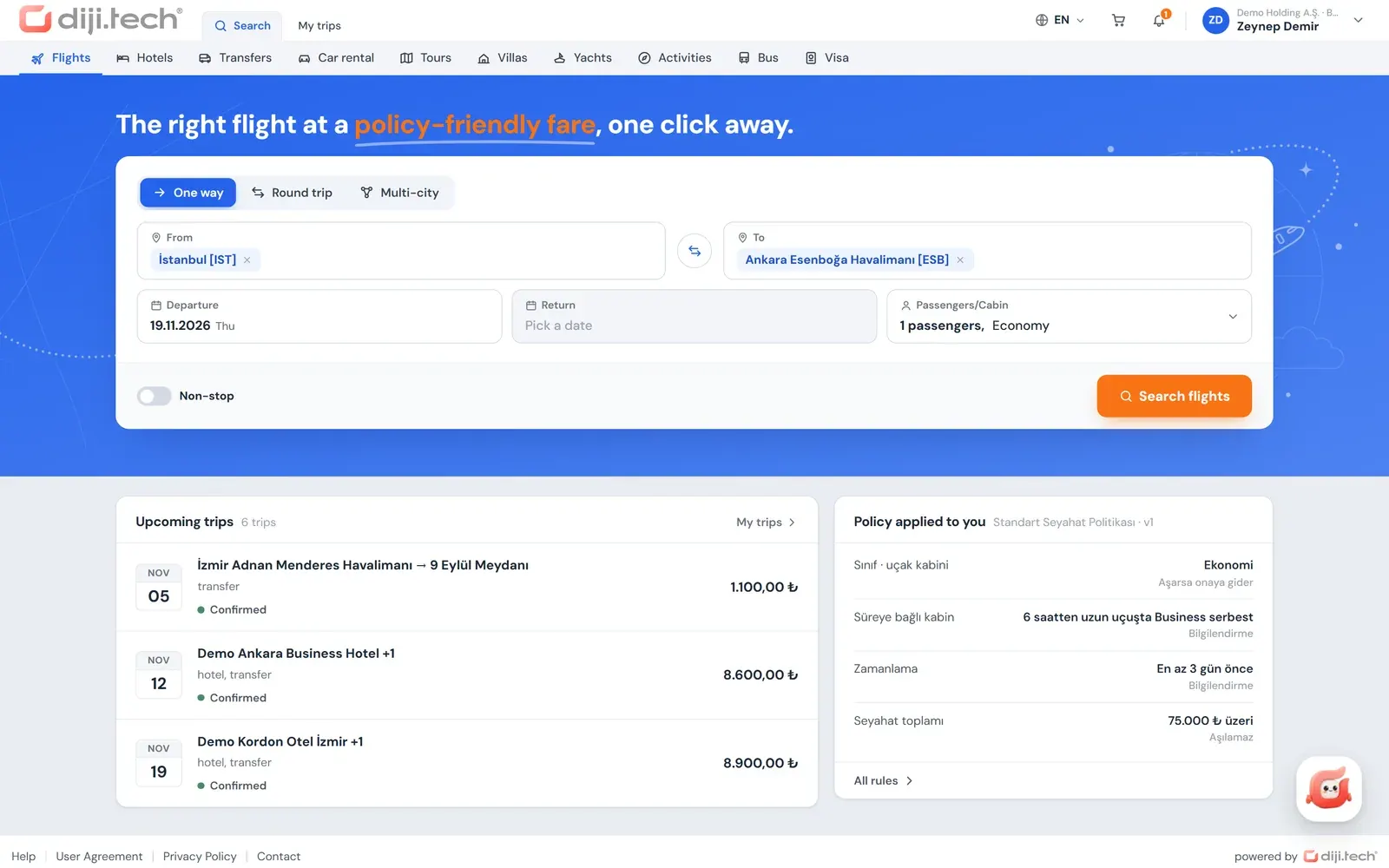
In Kurumsal.pro this relationship starts at search. In the results the employee sees, on every row, the policy decision that applies to them: in policy, out of policy with the reason, or blocked. In the cart, a reason is entered for an out-of-policy item. At submission the system chooses the route itself: "Send for approval" if there is a policy violation that needs approval, a budget overrun that sends the cart to approval or an approve-every-request rule, otherwise "Buy"; under a blocking rule the purchase cannot be made. In a request that goes to approval all items travel as one request, and the approver sees the request with its reason, its difference from the best option and its budget impact.
We described policy setup in travel policy software and level design in travel approval workflow.
What is the role of a travel agency in corporate travel management?
A travel agency takes on the operations side of corporate travel management: booking and ticketing, supplier relationships and pricing, invoicing, after-sales work such as cancellations and changes, and support when something goes wrong. An agency that serves corporate clients is usually called a travel management company (TMC). The company sets the rules, and the agency runs the service within them.
Many companies run travel management together with an agency. In Turkey an agency must hold a TURSAB licence (the Association of Turkish Travel Agencies) to sell. In the digital model the agency opens a corporate portal for its client under its own brand; the company's employees book there, the company administrator defines the rules, and the agency manages price, balance, invoicing and after-sales work in the background. This structure is also described as an agency, company, employee chain.
The agency can also sell phone and email requests on the company's behalf; these sales are made at the company's price and tied to the company's record. For more on the TMC concept, see advantages of working with a travel management company.
How does corporate travel management software work?
Corporate travel management software joins policy, approval, budget, booking, payment, documents and reports on one web platform. The company administrator defines the rules once; employees work with those rules at every booking; the agency manages price and operations; management follows the result in reports. Every step accumulates in the same trip record.
In Kurumsal.pro a typical trip runs in this order:
- Setup: the company administrator defines the company tree, departments, staff, roles, travel policy, approval flow and budgets.
- Search: the employee searches for flights, hotels or other products and sees the policy decision that applies to them on each result.
- Cart: all items of the trip go into one cart; a reason is entered for an out-of-policy item and a billing profile is chosen.
- Approval or purchase: if there is a violation or budget overrun that needs approval the request goes to approval; otherwise the purchase is made.
- Decision: the approver approves or rejects in the portal or from the single-use link in the email; after the final approval the purchase is made from the company wallet, and where needed an authorized approver or the company administrator completes the purchase in the portal.
- Documents: the travel plan, e-ticket, voucher and invoice PDFs are downloaded from the trip file.
- After-sales: if a cancellation or change is needed, the employee opens a request in the portal and it goes to the agency's operations team.
- Reporting: spending, policy compliance, savings, budget, traveler locator and carbon reports give management control.
The portal runs in Turkish and English, and because it is responsive web it can also be used in a mobile browser. A role-by-role summary of all features is on the corporate travel management software features page.
Are corporate travel management and expense management the same?
No. Corporate travel management covers pre-trip and booking: policy, approval, budget, purchase, invoicing and reporting. Expense management covers collecting, approving and reimbursing receipts for meals, taxis, parking and similar spending during the trip. The two areas complement each other but are different software needs.
Making this distinction clear prevents the wrong expectation when you choose software. Kurumsal.pro is a corporate travel management system; it has no expense, receipt collection or per diem calculation module. Spending that comes from bookings, however, is followed in reports: the spending, budget, finance and sales statement reports show the cost of flights, hotels and other products by department, company, branch and person. We explained the topic in more detail in the difference between travel management and expense management.
What does corporate travel management give a company?
Corporate travel management gives a company control, visibility and time. Rules apply on their own at every booking, spending is followed period by period, approvals do not get lost in email chains and invoices are issued to the right title. Once the system is measurable, savings opportunities become visible in the reports. Employees also decide faster because they know the rules beforehand.
The concrete benefits can be summarized as follows:
- Policy compliance: rules are visible at search time; an out-of-policy choice needs a reason and approval.
- Budget discipline: the amount sent for approval is deducted from the budget as a commitment; authorized managers and the finance team follow the remainder on the dashboard and in the budget report.
- Savings visibility: the savings report shows the gap between the chosen option and the best option, in other words the missed saving.
- Correct invoicing: company and branch billing profiles let the invoice go to the right legal entity.
- Employee experience: employees book for themselves, reach their documents in one place and follow the approval process in the portal.
The size of these benefits depends on a company's travel volume and how its rules are set, so we give no percentage here. Figures should be read from the company's own reports once the system is running.
What should you look at when choosing corporate travel management software?
The first thing to check is whether the components work in connection with each other: is policy applied at search, does approval talk to the budget, is purchase in the same record as approval, is the invoice issued to the right profile? The second is compatibility with the agency the company works with; the third is security and data privacy.
A short checklist:
- Do the policy rule types cover your company's rules (cabin, hotel stars, nightly limit, difference from the best option, risky country)?
- Can the approval flow define sequential and parallel levels, amount bands and delegates?
- Are there inform, reason, approval or block options when a budget is exceeded?
- Are the products your company needs (flights, hotels, transfers, car rental, buses, visas) in the same cart?
- Are there safeguards such as two-step verification, role-based permissions and ID number masking?
- If you need expense management, SSO or a native mobile app, does the system state clearly whether they are in scope?
A more detailed selection guide is in how to choose corporate travel software.
Where does Kurumsal.pro stand in this process?
Kurumsal.pro is a corporate travel management software system on DIJI.TECH infrastructure that travel agencies offer their corporate clients under their own brands. The company receives the portal from its agency; the portal opens with the agency's brand, domain and prices. The agency manages its corporate clients, prices, balances and invoices from the agency panel on the same infrastructure, and sells phone requests on a company's behalf from there.
According to DIJI.TECH, the company has been the technology partner of 50+ brands since 2019, and setup and delivery take one week on average. If you are a company, you can ask the agency you work with about this portal; if you are an agency, you can request a demo to see how you would open the system to your corporate clients.
Frequently asked questions
What is corporate travel management?
It is the work of running employees' business trips, from request, approval, budget control, booking, payment and invoicing to reporting, in one order according to company rules. The aim is a trip that is easy for the employee and controlled, measurable and policy-compliant for the company.
What components does corporate travel management have?
The core components are travel policy, pre-trip approval, budget control, booking, payment and invoicing, reporting, and traveler profiles and documents. They are linked: for example an out-of-policy booking goes to approval, the approved amount is deducted from the budget, and then it appears in a report.
What is the role of a travel agency in corporate travel management?
The agency makes the booking or lets staff make it, manages supplier relationships and pricing, issues the invoice and carries out after-sales work such as cancellations and changes. In the digital model the agency offers this service to the company through a corporate portal under its own brand.
What does corporate travel management software do?
It joins policy, approval, budget, booking, payment, documents and reports on one platform. The employee sees the policy decision that applies to them in search results, a request goes to approval when needed, purchase and documents are created in the same record, and management follows spending through reports.
Are corporate travel management and expense management the same?
No. Travel management covers pre-trip and booking: policy, approval, budget, purchase and invoice. Expense management is the collection and reimbursement of receipts for meals, taxis and similar spending during the trip. Kurumsal.pro has no expense, receipt or per diem module.
Which companies need corporate travel management?
Companies with employees who travel regularly, several branches or departments, and a wish to control travel spending through budget and policy benefit most. As trip numbers grow, a process run by email and spreadsheets costs both time and control.
Can corporate travel management software be used on mobile?
The Kurumsal.pro portal is a responsive web application and works in a mobile browser; search, the cart, trips and one-click approval from email can be done on a phone. There is no native iOS or Android app.