Written by the DIJI.TECH team.
Business travel emissions are estimated by multiplying activity data by a conversion factor: passenger-kilometres for flights, room-nights for hotels, and kilometres for cars and transfers. The result is expressed in kg CO2e (carbon dioxide equivalent). Companies do not produce the factors themselves; they take them from an official set, and the most common source in corporate reporting is the set the UK government publishes every year, known in the industry as the DEFRA factors. This article explains the method product by product and shows how a travel portal's carbon report uses it.
Why are business travel emissions measured?
Business travel emissions are measured because they are part of a company's greenhouse gas inventory. In greenhouse gas reporting, emissions are divided into scopes; the 2026 DESNZ methodology paper gives business travel in vehicles the company does not own or control as an example of Scope 3 (other indirect) emissions. Hotel accommodation is also reported as Scope 3 emissions linked to business travel.
The practical benefit of measuring is that it makes the climate impact of travel decisions visible. Without knowing which department, which routes and which cabin class make up most of the total, no reduction target can be set. Whether measurement is a legal requirement depends on the company's size, sector and the regulations it is subject to; this article contains no legal assessment.
What formula is used to calculate carbon emissions?
There is one basic formula: activity data × conversion factor = emissions (kg CO2e). What differs is what the activity data measures for each product and how finely the factor is chosen. The table below summarises the general approach for travel products.
| Product | Activity data | What the factor depends on |
|---|---|---|
| Flight | Passenger-kilometres (distance × number of passengers) | Distance band and cabin class |
| Hotel | Room-nights (rooms × nights) | Country where the hotel is |
| Car rental | Vehicle-kilometres | Vehicle type, size or fuel |
| Transfer | Vehicle-kilometres | Vehicle type |
The DESNZ factor set is updated every year. The 2026 set was published on GOV.UK on 11 June 2026; its main documents are the full set of factors, the methodology paper, and the update paper that describes changes from the previous year. When you calculate, always write in your report which year's set you used, because factors can change from year to year.
How are flight emissions calculated?
A flight's emissions are found by multiplying the distance of the flight leg by the number of passengers and the appropriate factor. Distance is the great circle distance between the two airports, the shortest path on the earth's surface. The factor is chosen by the flight's distance band and cabin class.
The DESNZ methodology paper gives an important detail on distance: aircraft do not often fly the exact great circle route; indirect routings, stacking and delays lengthen the distance. An 8% uplift to the great circle distance is therefore recommended, and it has already been applied to the factors in the 2026 set. In other words, when using the DEFRA factor you do not need to add 8% to the great circle distance yourself.
The calculation steps are:
- Find the great circle distance from the coordinates of the departure and arrival airports.
- Determine the flight's distance band (domestic, short-haul, long-haul).
- Determine the cabin class (economy, premium economy, business, first).
- Select the factor that matches the band and cabin.
- Calculate the leg's emissions as distance × factor × number of passengers; for a connecting flight, add up the legs.
How does DEFRA separate short-haul and long-haul?
In the DEFRA set, flights are divided into three bands: domestic, short-haul and long-haul. The domestic band is defined for flights within the UK. For short-haul versus long-haul there are two approaches, and knowing the difference matters when assessing flights from Turkey.
According to the methodology paper, earlier versions used a rough rule under which flights below 3,700 km were short-haul and those above were long-haul; that limit was based on the maximum range of a Boeing 737. The paper finds this approach simplistic and now prefers a geographic definition that is consistent with statistical data: flights between the UK and Europe (including Turkey) and North Africa are short-haul, while flights to the Americas, Asia, most of Africa and Australasia are long-haul.
These definitions are written for flights between the UK and other countries. When applying them to flights from Turkey you have to pick an approach: treating flights within the same country as domestic and separating short and long haul by a distance limit is a practical and explainable way. Whichever rule you choose, state it in the methodology note.
Why does cabin class change the emissions?
Cabin class changes the emissions because the fuel an aircraft burns belongs to the aircraft, not to the seats, and each seat's share is distributed by the area the seat takes up. Business and first class seats take up more space than an economy seat, so the aircraft carries fewer passengers and the emissions per passenger rise.
The DESNZ methodology paper notes that on long-haul flights a first class seat can take up more than 3 to 6 times the space of an economy seat. The class distinction is therefore marked on long-haul flights; on domestic flights no class distinction is made because the extra area taken by premium seats is not considered significant. For companies this means that cabin policy is one of the most direct decisions affecting emissions.
What is radiative forcing (RF), and should it be included?
Radiative forcing refers to aviation's non-CO2 climate effects: water vapour, contrails and nitrogen oxides. DEFRA's standard flight factors cover only direct CO2, CH4 and N2O emissions; for the non-CO2 effects, separate tables give factors that include radiative forcing.
The DESNZ methodology paper suggests a multiplier of 1.7 as a central estimate for these effects and states that it applies to the CO2 component only. The paper also stresses that the uncertainty of this multiplier is high and that a multiplier is not a true measure of CO2 equivalence. The practical rule for companies is: say clearly whether you report with or without RF, and keep the same approach across years; otherwise year-on-year comparison loses its meaning.
How are hotel stay emissions calculated?
Hotel emissions are estimated as number of rooms × number of nights × the factor for the country the hotel is in. The "Hotel Stay" table in the DEFRA set gives factors per country in CO2e. The calculation is simple, but you need to know the data behind the factor in order to read the result correctly.
According to the methodology paper, the hotel factors are taken from the Cornell Hotel Sustainability Benchmarking tool developed by the International Tourism Partnership and Greenview, and have not changed since the 2022 set. The paper also states the limits of this data plainly:
- The data is skewed toward large, upscale and chain hotels; lower-segment hotels are less represented.
- The data sets have not been verified, so they cannot be said to be fully accurate.
- A large share of the benchmarks (65%) comes from hotels in the United States.
- The factors do not distinguish facilities such as a hotel's restaurant, gym or pool.
A hotel figure therefore shows not the real performance of one hotel but the estimated impact of an average stay in that country.
How are car rental and transfer emissions estimated?
Car rental and transfer emissions are estimated by multiplying the kilometres travelled by the vehicle factor. The DEFRA set gives per-kilometre factors for passenger cars by engine size, fuel type and market segment. The difficulty is not in the factor but in the activity data: at the time of booking it is usually not known how many kilometres the vehicle will cover.
In corporate reports the estimate is therefore made using a default distance per rental day or per transfer. Where the real kilometres are known (for example the mileage recorded when the vehicle is returned), real data should replace the estimate. For a transfer, the distance can also be estimated from the road between the pick-up and drop-off points.
What does a corporate portal's carbon report show?
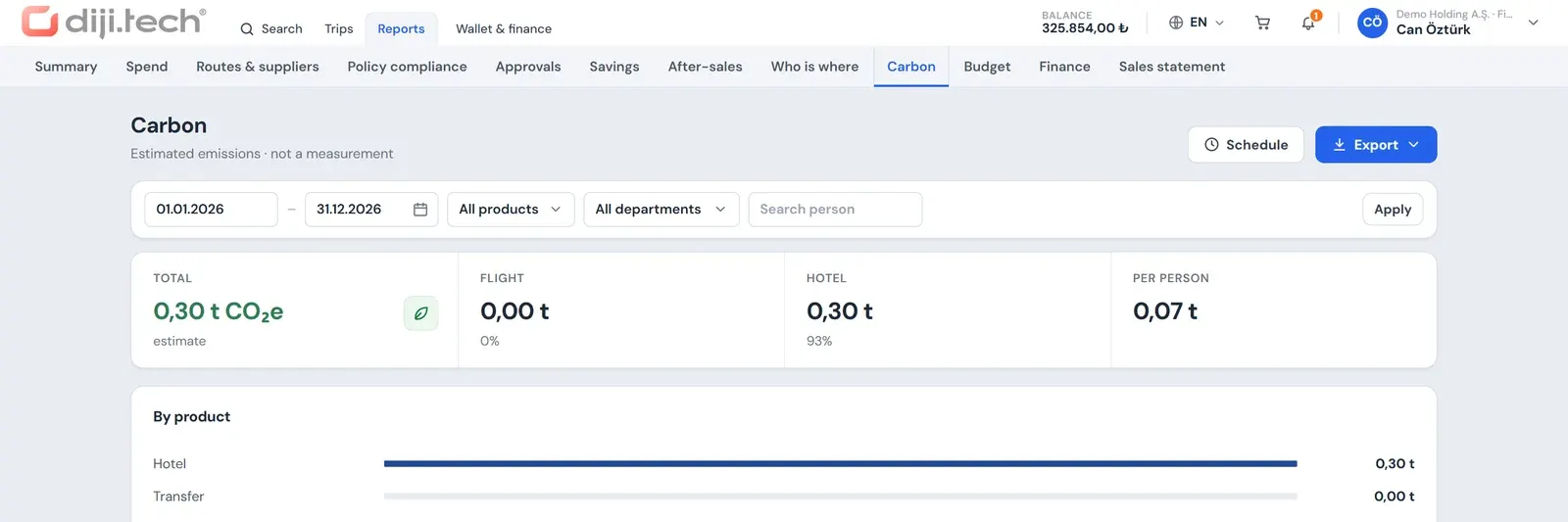
The Reports section of the Kurumsal.pro portal, which an agency opens to its corporate clients, includes a carbon report. It calculates the estimated emissions of trips made in the portal using the method above:
| Product | Calculation in the portal |
|---|---|
| Flight | Great circle distance of the leg × factor for distance band and cabin × number of passengers; the bands are based on DEFRA business travel bands |
| Hotel | Rooms × nights × country factor |
| Car rental and transfer | Estimated kilometres × vehicle factor |
For flights, the report places a leg within the same country in the domestic band, legs under 3,700 km in the short band and legs above it in the long band; that is, it uses the distance-limit approach described above. The report screen notes that the figures are estimates. The factors are managed by the platform; a company administrator or the agency does not change factors on screen.
Like other reports, the carbon report is narrowed to the user's role scope, works for periods of at most 370 days, and can be exported as Excel, CSV or PDF. Reports can also be emailed monthly or weekly. The full list of reports is on the corporate travel reporting page, and scheduled reports are covered in travel management tools with automatic reporting.
Why are the figures estimates, and how should the report be used?
Travel emissions figures are estimates because they use factors derived from averages, not the actual fuel the airline burned on that flight or the actual energy the hotel used that night. This does not make the figures worthless; calculated with a consistent method, they show the trend, the distribution and the effect of reductions reliably.
When using the report, keep these principles in mind:
- Write down the method: Add the factor source, year, whether radiative forcing is included and the distance-band rule to the report's methodology note.
- Stay consistent: Use the same method if you compare across years; if the factor year changed, say so.
- State the scope: Bookings made outside the portal do not enter the report; if you report total travel emissions, fill this gap separately.
- Use it for the right purpose: DESNZ states that using the factors for other purposes is the user's responsibility; if you are preparing an official sustainability report, check the method rules of the standard you are subject to.
How can travel policy be used to reduce emissions?
The decisions that most affect travel emissions are whether to travel, the distance, and the cabin class. Travel policy touches two of these directly: it determines which requests go through approval and which cabin may be used.
Among the policy rules in the Kurumsal.pro portal are the aircraft cabin limit (the highest permitted cabin), the permitted cabin on long flights (with a duration threshold), approval on every request, and a hotel star limit. These rules are not designed specifically for emissions, but because they make the cabin decision systematic they also affect emissions. The carbon report lets you follow the effect of the policy across periods. All rule types are on the travel policy software page, and which metrics to follow together in how to prepare corporate travel reports. To see the carbon report with sample period data and discuss the methodology note with your team, you can book a demo.
Sources
Frequently asked questions
What formula is used to calculate business travel emissions?
The basic formula is activity data × conversion factor = emissions. Activity data is passenger-kilometres for flights, room-nights for hotels and kilometres for cars and transfers. Factors in kg CO2e are taken from an official set, for example the DEFRA factors published by DESNZ.
What are the DEFRA conversion factors?
They are the greenhouse gas conversion factors the UK government publishes every year for company reporting. They are now published by the Department for Energy Security and Net Zero (DESNZ) but are still known in the industry as the DEFRA factors. The 2026 set was published on 11 June 2026; its main documents are the full set of factors, the methodology paper and the update (change) paper.
Does a business class flight produce more emissions than economy?
Yes. Under the DEFRA method, business and first class seats take up more space on the aircraft than an economy seat, so emissions per passenger are calculated as higher. The methodology paper notes that on long-haul flights a first class seat can take up more than 3 to 6 times the space of an economy seat. No class distinction is made for domestic flights.
What is radiative forcing (RF), and should it be included?
Radiative forcing refers to aviation's non-CO2 climate effects such as water vapour, contrails and nitrogen oxides. DEFRA suggests a multiplier of 1.7 as a central estimate for these effects, stresses that the uncertainty is high, and gives factors with and without RF in separate tables. You need to state clearly in your report which you used.
How are hotel stay emissions calculated?
They are estimated as number of rooms × number of nights × the factor for the country the hotel is in. DEFRA's hotel factors come from the Cornell Hotel Sustainability Benchmarking tool, have not changed since 2022, and are skewed toward large, upscale and chain hotels.
Are the figures in the Kurumsal.pro carbon report exact?
No, they are estimates, and the report says so on screen. The calculation uses booking data and conversion factors; the airline's or hotel's actual fuel and energy use is not used. The factors are managed by the platform, and a company or agency does not change factors on screen.